
 Terrorism, like assassination, is violence with a political purpose. An assassination might also be intended to create terror, but the main objective is to eliminate a specific target. In contrast, terrorism is not aimed at elimination of a specific target; the goal is to create fear and almost any victims will suffice.
An individual terrorist might have any number of motives ranging from the ideological to the personal. Perhaps the terrorist sincerely believes that God loves the murder of innocents. Perhaps the terrorist was rejected by someone they were infatuated with and is lashing out in rage. While speculation into the motives of such people is interesting and important, behind all true terrorism lies a political motivation, although this motivation might be on the part of those other than the person conducting the act.
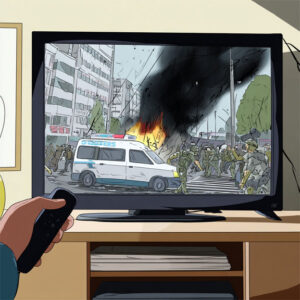
While a terrorist attack can create fear on the local level by itself, terrorists need the media and social media to spread their terror on a large scale. The media is always happy to oblige. While this coverage can be defended on the grounds that people have a right to know the facts, the coverage does have some important and (hopefully) unintended consequences.
One effect of extensive media coverage is to serve as an impact multiplier. The whole world is informed of the terrorist act and the group that claims credit gains terrorist credibility and status. This improves the influence of the group and enhances its ability to recruit as the group is getting free advertising. Assuming that aiding terrorists is morally wrong, this coverage is morally problematic.
A second effect of the coverage is that it fuels the spotlight fallacy. This is a fallacy in which a person estimates the chances that something will happen based on how often they hear about it rather than based on how often it occurs. Terrorist attacks in the West are very rare and what Americans should really be worried about, based on statistics, is poor lifestyle choices that are encouraged by businesses. These include the use of tobacco, over consumption of alcohol, misuse of pain killers, eating unhealthy food and driving automobiles. Since terrorist attacks are covered relentlessly in the news and the leading causes of premature death are not, it is easy for people to overestimate the danger posed by terrorism. And underestimate what will probably kill them.
A third effect of coverage is that it can make people victims of the fallacy of misleading vividness. This fallacy occurs when a person overestimates the chances that something will occur based on how vivid or extreme the event is. While the media typically exercises some restraint in coverage, terrorism is obviously scary to most and this can cause people to psychologically overestimate the threat.
Whether a person falls victim to the spotlight fallacy or misleading vividness, the result is the same: the person overestimates the danger and is thus more afraid then they should be. This has beneficial effects for those who wish to exploit this fear.
Obviously enough, the terrorists aim to exploit the fear they create. They want people to believe that they are in terrible danger and face an existential threat. Lacking the capacity to engage in actual war, they must make use of the strategy of terror. These two fallacies are critical weapons in their war and people who fall victim to them have allowed the terrorists to win.
One of the ironies of terrorism is that there are American politicians who exploit the fear created by terrorists and use it to influence people for their political ends. While they do not deploy the terrorists, they benefit from the attacks as much as the masters of the terrorists do.
Not surprisingly, they make use of some classic fallacies: appeal to fear and appeal to anger. An appeal to fear occurs when something that is supposed to create fear is offered in place of actual evidence. In the case of an appeal to anger, the same sort of thing is done, only with anger. This is not to say that something that might make a person afraid or angry cannot serve as actual evidence; it is that these fallacies offer no reason to support the claim in question and only appeal to emotions.
Interestingly, terrorists like ISIS and the American politicians that exploit them have very similar objectives. Both want to present the fight as a clash of cultures, the West (and Christianity) against Islam. They both want this for similar reasons: to increase the number of their followers and to keep the conflict going so it can be exploited to fuel their political ambitions. If Muslims are accepted by the Western countries, then the terrorist groups lose influence and propaganda tools and thus lose recruits. If Muslims accept the West, then the Western political groups exploiting fear of Islam also lose influence and propaganda tools and thus lose recruits.
Both the terrorists and their Western exploiters want to encourage Westerners to be afraid of refugees coming from conflict areas in the Middle East. After all, if the West takes in refugees and treats them well, this is a loss of recruits and a propaganda loss for the terrorists. It is also a loss for those who try to build political power on fear and hatred of refugees.
If refugees have no way to escape conflict, they will be forced to be either victims or participants. Children who grow up without education, stability and opportunity will also be much easier to recruit into terrorist groups. This is all in the interest of the terrorists; but also, the Western political groups who want to exploit terrorism. After all, these groups are founded on identity politics and need a scary “them” to contrast with “us.”
This is not to say that the West should not be on guard against possible attacks or that the West should not vet refugees. My main point is that overreacting to terrorism only serves the ends of the wicked, be they actual terrorists or those in the West who would exploit this terror to gain power.