
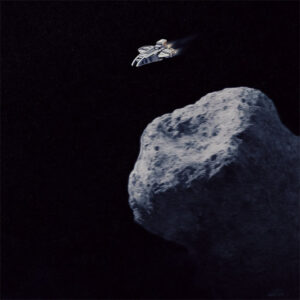
 While asteroid mining is still science fiction, companies are already preparing to mine the sky. While space mining sounds awesome, lawyers are murdering the awesomeness with legalize. Long ago, President Obama signed the U.S. Commercial Space Launch Competitiveness Act which seemed to make asteroid mining legal. The key part of the law is that “Any asteroid resources obtained in outer space are the property of the entity that obtained them, which shall be entitled to all property rights to them, consistent with applicable federal law and existing international obligations.” More concisely, the law makes it so that asteroid mining by U.S. citizens would not violate U.S. law.
While this would seem to open the legal doors to asteroid mining, there are still legal barriers, although the law is obviously make-believe and requires that people either are willing to follow it or the people with guns are willing to shoot people for not following it. Various space treaties, such as the Outer Space Treaty of 1967, do not give states sovereign rights in space. As such, there is no legal foundation for a state to confer space property rights to its citizens based on its sovereignty. However, the treaties do not seem to forbid private ownership in space—as such, any other nation could pass a similar law that allows its citizens to own property in space without violating the laws of that nation. Obviously enough, satellites are owned by private companies and this could set a precedent for owning asteroids, depending on how clever the lawyers are.
One concern is that if several nations pass such laws and people start mining asteroids, then conflict over valuable space resources will be all but inevitable. In some ways this will be a repeat of the past: the more technologically advanced nations engaged in a struggle to acquire resources in an area where they lack sovereignty. These past conflicts tended to escalate into wars, which is something that must be considered in the final frontier.
One way to try to avoid war over asteroids is new treaties governing space mining. This is, obviously enough, a matter that will be handled by space lawyers, governments, and corporations. Unless, of course, AI kills us all first. Then they can sort out asteroid mining.
While the legal aspects of space ownership are interesting, its moral aspects of ownership are also of concern. While it might be believed that property rights in space are entirely new, this is not the case. While the setting is different than in the original, the matter of space property matches the state of nature scenarios envisioned by thinkers like Hobbes and Locke. To be specific, there is an abundance of resources and an absence of authority. As it now stands, while no one can hear you scream in space, there is also no one who can arrest you for space piracy as long as you stay in space.
Using the state of nature model, it can be claimed that there are currently no rightful owners of the asteroids, or it could be claimed that we are all the rightful owners (the asteroids are the common property of all of humanity).
If there are currently no rightful owners, then the asteroids are there for the taking: an asteroid belongs to whoever can take and hold it. This is on par with Hobbes’ state of nature—practical ownership is a matter of possession. As Hobbes saw it, everyone has the right to all things, but this is effectively a right to nothing—other than what a person can defend from others. As Hobbes noted, in such a scenario profit is the measure of right and who is right is to be settled by the sword.
While this is practical, brutal and realistic, it is a bit problematic in that it would, as Hobbes also noted, lead to war. His solution, which would presumably work as well in space as on earth, would be to have sovereignty in space. This would shift the war of all against all in space (of the sort that is common in science fiction about asteroid mining) to a war of nations in space (which is also common in science fiction). The war could, of course, be a cold one fought economically and technologically rather than a hot one fought with mass drivers and lasers.
If asteroids are regarded as the common property of humanity, then Locke’s approach could be taken. As Locke saw it, God gave everything to humans in common, but people must acquire things from the common property to make use of it. Locke gives a terrestrial example of how a person needs to make an apple her own before she can benefit from it. In the case of space, a person would need to make an asteroid her own to benefit from the materials it contains.
Locke sketched out a basic labor theory of ownership—whatever a person mixes her labor with becomes her property. As such, if asteroid miners located an asteroid and started mining it, then the asteroid would belong to them. This does have some appeal: before the miners start extracting the minerals from the asteroid, it is just a rock drifting in space. Now it is a productive mine, improved from its natural state by the labor of the miners. If mining is profitable, then the miners would have a clear incentive to grab as many asteroids as they can, which leads to the moral problem of the limits of ownership.
Locke does set limits on what people can take in his proviso: those who take from the common resources must leave as much and as good for others. When describing this to my students, I always use an analogy to a party: since the food is for everyone, everyone has a right to the food. However, taking it all or taking the very best would be wrong (and rude). While this proviso is ignored on earth, the asteroids could provide us with a fresh start in terms of dividing up the common property of humanity. After all, no one has any special right to claim the asteroids—so we all have equal good claims to the resources they contain.
As with earth resources, some will contend that there is no obligation to leave as much and as good for others in space. Instead, those who get there first will contend that ownership should be on the principle of whoever grabs it first and can keep it is the “rightful” owner. Unless someone grabs it from them, then they would presumably see that as a cruel injustice.
Those who take this view would probably argue that those who get their equipment into space would have done the work (or put up the money) and (as argued above) would be entitled to all they can grab and use or sell. Other people are free to grab what they can, if they have access to the resources needed to mine the asteroids. Naturally, the folks who lack the resources to compete will remain poor—their poverty will, in fact, disqualify them from owning any of the space resources much in the way poverty effectively disqualifies people on earth from owning earth resources.
While the selfish approach will be appealing to those who can grab the asteroids, arguments can be made for sharing them. One reason is that those who will mine the asteroids did not create the means to do so from nothing. Reaching the asteroids will be the result of centuries of human civilization that made such technology possible. As such, there would seem to be a general debt owed to human civilization and paying this off would involve also contributing to the general good of humanity. Naturally, this line of reasoning can be countered by arguing that the successful miners will benefit humanity when their profits “trickle down” from space. Sadly, as on earth, gravity does not seem to affect money in terms of trickling it down. It always seems to go upwards.
Another way to argue for sharing the resources is to use an analogy to a buffet line. Suppose I am first in line at a buffet. This does not give me the right to devour everything I can with no regard for the people behind me. It also does not give me the right to grab whatever I cannot eat myself to sell it to those who had the misfortune to be behind me in line. As such, these resources should be treated in a similar manner, namely fairly and with some concern for those who are behind the first people in line.
Naturally, these arguments for sharing can be countered by the usual arguments in favor of selfishness. While it is tempting to think that the vastness of space will overcome selfishness (that is, there will be so much that people will realize that not sharing would be absurd and petty), this seems unlikely—the more there is, the greater the disparity is between those who have and those who have not. On this pessimistic view we already have all the moral and legal tools we need for space—it is just a matter of changing the wording a bit to include “space.”
 In the previous essay on threat assessment, I looked at the influence of availability heuristics and fallacies related to errors in reasoning about statistics and probability. This essay continues the discussion by exploring the influence of fear and anger on threat assessment.