
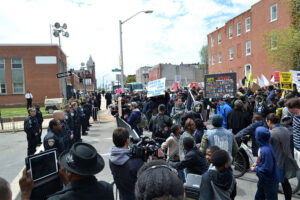
On April 12, 2015 Freddie Gray died in police custody. For some, this was part of a pattern of police violence. For others (such as Fox hosts), this was just another isolated incident.
The initial protests to this death were peaceful and it was hoped by many that Baltimore would avoid the violence that marked other protests (including riots in Baltimore’s own past). This hope was shattered in an outbreak of violence and destruction.
One obvious concern is the identity and the nature of those engaged in violence. According to some narratives, the rioters were thugs or outsiders taking advantage of the situation to engage in destruction, theft and violence. That is, they are opportunists and not protestors.
The United States does have a history of costly and pointless riots that are not protests. These are, of course, sports riots. One outstanding example is the 1992 riot in the aftermath of the Chicago Bulls vs. the Portland Trail Blazers. The damage was estimated at $10 million. There have been other lesser riots, such as that following the 1999 Michigan State vs. Duke game that resulted in about $250,000 in damage (and whose iconic photo is a shirtless white bro “flashing the horns” atop a burned-out car). My adopted state of Florida also sees violence and property damage during Spring Break, although California did seem interested in getting into the spring break riot game.
Given that Americans are willing to riot over sports and spring breaks, it is reasonable to consider that the rioters in Baltimore were not protesting but were motivated by other reasons, perhaps just wanting to break and burn things.
There are some narratives that cast at least some of the rioters as having also been protesting. That is, their motivation is not just to steal, break and burn but to express their anger about the situation. One way to explore motivations is to consider the situation in Baltimore. That is, to see if there were legitimate grounds for anger and whether these factors might have provoked people to violence and destruction.
Baltimore was (and still is) a paradigm of the brutal race and class divisions in the United States. It has the historical distinction of being the first city to pass a citywide segregation law (segregating each residential block by race) and the legacy of this law persists as Baltimore remains a segregated city. In the center of the city, 60% of the population is black. The suburbs are predominantly white. Despite there being laws against forced segregation, the United States is still highly segregated. This provides grounds for anger.
Baltimore also exemplifies the stark class divisions in the United States. Back in 2015, 150,000 of the city’s 620,000 were classified as poor (the average income for a family of four being $23,492). The unemployment rate was close to 10%. As the American Revolution showed, people get angry and violent in response to perceived economic injustice. Given the massive disparity between economic classes in the United States and their support by the structures of law and authority, what is shocking is not that there is an occasional riot but that there are not daily riots. As such, there were sufficient grounds for anger. Naturally, some people claimed that this poverty is because the poor are lazy: if they would only work hard for the job creators, they would not be poor. This view ignores the reality of poverty in America, but it is a beloved narrative of those who are doing well.
Not surprisingly, Baltimore also has had serious issues with crime. Drug addiction was a serious problem and the city was 5th in the number of murders per year in 2014. It was, however, 15th in the number of violent crimes per year. Crime is, of course, a complex matter. Some claim that this sort of crime arises from poverty, oppression and lack of opportunity (as opposed to the ‘crimes’ of the financial classes, such as destroying the world economy). There is, of course, a correlation between crime and these factors. Some claim that people turn to crime because of moral defects rather than these factors. This does have some merit. After all, a look at the financial sector and halls of power show evil behavior that is clearly not caused by poverty.
Like other US cities, there was also an issue with how the police treat their fellow citizens. In 2011 the city paid $6.3 million settling police misconduct claims. Between 2011 and 2012 there were 156 such lawsuits. The number did decline to 156 from 2013 to 2014. While it is reasonable to consider that not all these suits had merit, what happened to Gray does provide reason to suspect that there are grounds for being concerned about policing in the city.
When people think they are being oppressed and subject to brutality, they respond with anger. For example, one can see the rage the fine folks on Fox express when they speak of the War on Christmas and how Christians are being mistreated and persecuted in America. One can only imagine the anger that arises when people really are subject to mistreatment. As such, there seem to be legitimate grounds for anger.
While the anger of those engaged in violence might have been justified, there is still the obvious concerns about whether such behavior is morally acceptable and whether such behavior is effective in achieving goals.
On the face of it, much of the violence and destruction would seem to be difficult to justify morally. Most of the destruction seemed to involve community infrastructure and the property of people who were not responsible for what provoked the protests. While the anger against the police was understandable, the attacks on reporters and firefighters were unjustified. The reporters did nothing meriting being attacked and the firefighters were trying to keep the city from burning down, which is certainly a laudable goal. Crudely put, if the violent (alleged) protestors were striking against injustice, they were (mostly) hitting the wrong targets. To use an analogy, if Bob has wronged Sam and Sam smashes Sally’s windows because he lives near her and cannot get at Bob, then Sam has acted wrongly, no matter how badly Bob wronged him.
It might be countered that the destruction is morally acceptable because the (alleged) protestors are striking out against an unjust social order. The obvious reply is that while this might have some abstract appeal, the real damage is being done mainly to the innocent rather than the guilty. As such, the violence and destruction seem to have been immoral.
A second issue, which can connect to the moral issue, is the effectiveness of violence as a means of protest and social change. Obviously, violence can be very effective in achieving goals. We Americans can point to our own Revolutionary War and the wars won against everyone from the Apache to the Japanese. However, violence is only effective when one has enough power to achieve one’s goals through that violence. Since the rioters went up against the police and the National Guard, it makes sense why they could not achieve victory through force of arms.
However, a case can be made that violence gets attention. Peaceful protests, one might argue, sound nice but are easy to ignore. After all, “change things or we will peacefully protest again” has less power than “change things or there will be cop cars burning in the streets and the authorities will have to explain why they are losing control of the city.” Interestingly, many of the pundits who praised the property destruction that occurred during the Boston Tea Party are quick to condemn contemporary protests they do not like. These pundits also praise other violence they approve of but lack a consistent principle regarding violence as a means of achieving goals beyond they like violence aimed at goals they like and dislike violence that is aimed at goals they dislike.
A moral case can be made against violence, such as that famously made by Dr. King. When there is the possibility of redress and justice through peaceful means, then non-violence seems to have an obvious advantage over violence: people are not hurt or killed, and property is not destroyed. However, the fact that a major American city had to be patrolled by the National Guard showed once again that there are deep and profound problems in civil society. In 2025, it is equally evident that these underlying problems have not been addressed, and things are just getting worse.