
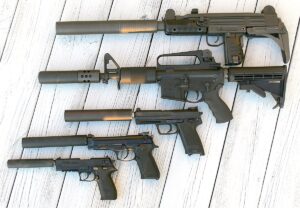
 Put a bit simply, a silencer is a device for suppressing the sound a gun makes when it fires. This is usually done to avoid drawing attention to the shooter. This makes an excellent analogy for what happens to proposals for gun regulation: the sound is quickly suppressed to ensure that it does not get too much attention.
Part of this suppression is deliberate. After each mass shooting, the NRA and similar groups step up pressure on their politicians to ensure new regulations are delayed, defeated or defanged. While it is tempting to cast the NRA as a nefarious player subverting democracy, the NRA seems to have mastered the democratic process: it organizes and guides motivated citizens to give money (which is used to lobby politicians) and to contact their representatives. This has often proven more effective than protests, sit-ins and drum circles. While it is true that the NRA represents only a fraction of the population, politics is like any sport: you must participate to win. While many citizens do not even bother to vote, NRA member turnout is apparently quite good. This is, of course, democracy. Naturally, another tale could be told of the NRA and its power and influence. A tale that presents the NRA and its members as subverting the will of the majority.
Certain pundits and politicians also engage in suppression. One standard tactic is, after a shooting, to claim that it is “too soon” to engage in discussion and lawmaking. Rather, the appropriate response involves thoughts and prayers. While it is appropriate to pay respects to the wounded and dead, there is a difference between doing this and trying to run out the clock with this delaying tactic. Those that use it know that if the discussion can be delayed, interest will fade and along with it the chances of any action being taken.
It is, in fact, appropriate to act as soon as possible. To use the obvious analogy, if a fire is ravaging through a neighborhood, then the time to put out that fire is now. This way there will be less need for moments of thoughts and prayers for victims.
Another stock tactic is to accuse those proposing gun regulation of playing politics and exploiting the tragedy to advance their agenda. This approach can have some moral merit; if a person is engaged in a Machiavellian exploitation of some awful event (be it a mass shooting, a terrorist attack, or a migrant committing murder) without real concern for others, then that person would be morally awful. That said, they could still be acting rightly, albeit for all the wrong reasons. This would be in terms of the consequences, which could be good despite the immoral motivation. For example, if a politician cynically exploited the harm inflicted by lead contaminated water to gain national attention so they could gain power and money, then that person would not be a good person. However, if this resulted in changes that reduced lead poisoning in the United States, then consequences would be good and desirable.
It is also worth considering that using an awful event to motivate change for the better could result from laudable motives and a recognition of how human psychology works. To use an analogy, a person who loves someone who just suffered from a lifestyle inflicted heart attack could use that event to get the person to change her lifestyle and do so for commendable reasons. After all, people are most likely to do something when an awful event is fresh in their minds; hence this is the ideal time to address a problem, which leads to the final part of the discussion.
Although active suppression can be an effective tactic, it often relies on the fact that interest in a matter fades as time passes. This is why those opposed to new gun regulation use delaying tactics. They know that public attention will shift and fade.
On the one hand, the human tendency to lose interest can be regarded as a bad thing. As Merlin said in Excalibur, “for it is the doom of men that they forget.” In the case of mass shootings and gun violence, people quickly forget an incident until the next mass shooting reminds them. This allows a problem to persist and is why action needs to be taken as soon as possible.
On the other hand, our forgetting is often our salvation. If the memory of fear and pain did not fade over time, they would be wounds that did not heal. Just as a person would bleed to death physically from wounds that never healed, a person would bleed out emotionally if memory did not fade.
To use another analogy, if the mind is like a ship and memory is like a cargo, just as a ship that could never lighten its load would plunge to the ocean floor, a person that could never lighten her emotional load would be dragged into the great abyss of emotions and thus be ruined. Thus, forgetting is both our doom and our salvation. Of course, we would have far less need to forget if we remembered what we need to fix. And fixed it.